ADU Cost in Marin County: 2026 Guide
Building an accessory dwelling unit (ADU) in Marin County is one of the best ways to add living space, house family, or generate long-term rental income. However, because of Marin’s terrain, labor market, and local permitting requirements, statewide cost averages simply do not apply here.
Whether you are considering a garage conversion in San Rafael or a detached backyard cottage in Mill Valley, here is a realistic, data-backed breakdown of what an ADU actually costs in Marin County in 2026.
The Quick Answer: $300,000 to $650,000+
If you want one number to plan around, use this: most ADUs built in Marin County in 2026 land between $300,000 and $650,000 all-in—covering design, permits, utility fees, site work, and construction. Garage and interior conversions can come in below that range, while a custom detached ADU on a hillside lot can go well above it.
Per square foot, Marin and San Francisco ADU work is commonly quoted at:
| Finish Level | Cost per Sq Ft |
| Lower range | $350 – $450 |
| Mid-range | $450 – $600 |
| High-end / custom | $600 – $800+ |
Why Per-Square-Foot Numbers Can Mislead
Per-foot averages distort the true cost of smaller units in a predictable way. A kitchen, a bathroom, a foundation, and utility hookups cost roughly the same whether the ADU is 450 or 850 square feet. When you spread those fixed costs over fewer square feet, the price per foot climbs.
Real Bay Area bid data shows that exact pattern:
| Detached ADU Size | Typical Bid per Sq Ft |
| 400 – 599 sq ft | $548 |
| 600 – 799 sq ft | $404 |
| 800 – 999 sq ft | $331 |
Marin then adds its own premium on top of Bay Area baselines—roughly 25% above Alameda and Contra Costa equivalents in the same bid data—driven by local labor rates, hillside lots, and strict review requirements.
Budgeting Takeaway: Pick a total budget range first, then choose a size and build type that fits it. Do not start from a per-square-foot number you found for another part of California—statewide averages of $150 to $300 per square foot will not build an ADU in Marin.
Cost by ADU Type: Conversions vs. New Builds
What you are building matters far more to your bottom line than how fancy the finishes are.
| ADU Type | Marin Planning Range | Why It Prices This Way |
| Junior ADU (JADU) (Inside existing home, up to 500 sq ft) | $125,000 – $250,000 | Walls, roof, and foundation already exist; work is mostly interior. |
| Garage Conversion | $175,000 – $325,000 | Structure exists, but plumbing, insulation, windows, and slab work are usually new. |
| Attached ADU / Addition | $325,000 – $550,000 | New construction that must tie into the existing house, roofline, and systems. |
| Prefab / Modular ADU | $300,000 – $550,000 | The factory unit can be fixed-price; the foundation, crane, and site utilities are not. |
| Detached New ADU | $400,000 – $700,000+ | A complete small house: foundation to roof, plus its own independent utility runs. |
Note: These are planning ranges for a properly permitted build by a licensed contractor, not formal quotes. Your specific lot will move you inside—or outside—these ranges. For a deeper look at the most budget-friendly route, read our Garage Conversion Guide.
Three Real-World Scenarios
Using mid-range Marin pricing, here is how different projects stack up:
500 sq ft detached ADU (flat lot, utilities nearby): Roughly $275,000 – $400,000 all-in.
800 sq ft detached ADU (mid-range finishes): Roughly $320,000 – $640,000 all-in, with most straightforward lots landing near the middle.
870 sq ft detached ADU on a hillside lot (our current Mill Valley build): Expect the top end of the range and above—not because the finishes are extravagant, but because engineered hillside foundations, grading, drainage, and material access sit on top of the unit’s base cost.
Where the Money Goes: The 4 Budget Buckets
A Marin ADU budget consists of four distinct buckets. Homeowners often get caught off guard when they only budget for the fourth one.
1. Design and Engineering ($15,000 – $40,000)
This covers architectural plans, structural engineering, Title 24 energy calculations, and a topographic site survey. Hillside lots, retaining walls, and sewer or septic challenges push this toward the top of the range. Skipping thorough engineering to save money up front is the most expensive mistake we see—it almost always comes back as a permit correction or a mid-build change order.
2. Permits and Fees ($10,000 – $30,000)
Building permit and plan check fees apply at every size. California estimates for an 800 sq ft detached ADU put standard permits and fees at roughly $16,000 to $27,000 before any impact fees. The biggest variable here is impact fees, which hinge on the 750-square-foot rule (detailed below).
3. Site Work and Utilities ($25,000 – $100,000+)
This is the true Marin wildcard:
Sewer lateral extensions: $8,000 to $35,000 depending on trench distance and depth.
Grading and retaining walls: $5,000 to $45,000+ on sloped lots.
System upgrades: Electrical main panel upgrades, water meter upsizing, drainage systems, and fire sprinklers all live in this bucket—and none of them appear in a glossy per-square-foot quote.
4. Construction (The Remainder of the Budget)
This covers framing, roofing, kitchen, bathroom, mechanical systems, and finishes. Finish level meaningfully moves the needle here: the exact same floor plan can swing $75,000 or more between durable mid-range finishes and custom millwork, natural stone, and panel-ready appliances.
Pro Tip on Contingency: Always set aside a 10–15% contingency on top of your construction contract. For a conversion of an older Marin garage or a steep hillside build, plan on 15–20%. Discovering hidden conditions once walls are opened or trenches are dug is normal—not bad luck.
Why Marin Costs More Than the Rest of California
Skilled Labor: Marin sits at the top of Bay Area labor pricing, and experienced crews are booked months in advance.
Hillside Topography: Mill Valley, Sausalito, Tiburon, Fairfax, San Anselmo, and Kentfield feature abundant hillside lots. Slopes require engineered foundations, retaining walls, complex drainage, and difficult material staging.
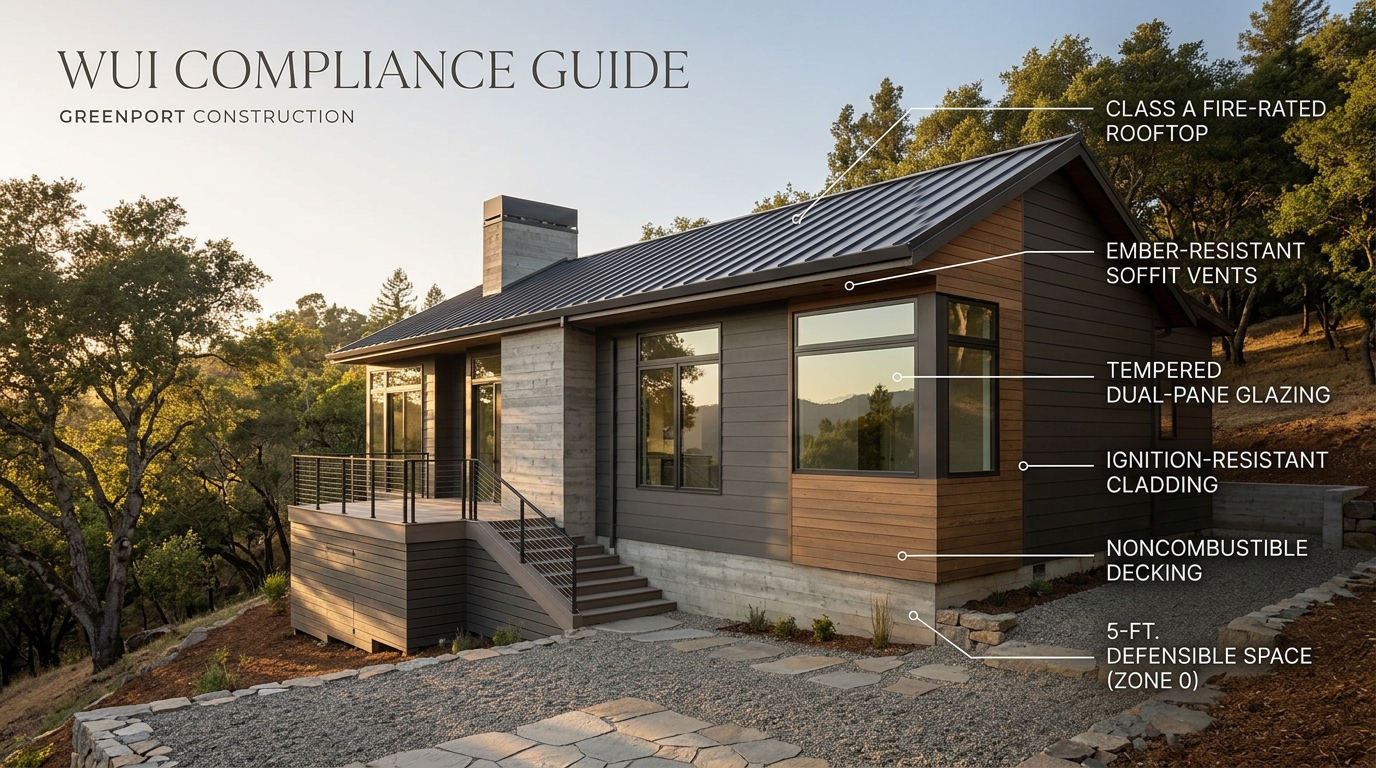
Wildfire Severity Zones: Much of southern and central Marin falls within Very High Fire Hazard Severity Zones (VHFHSZ), requiring Class A roofing, ignition-resistant siding, ember-resistant vents, and strict defensible-space compliance.
Water and Sewer Sign-Offs: Jurisdictions like Mill Valley require a will-serve letter from Marin Water alongside sanitary district service-availability letters before a building permit can be issued. Each utility step adds time and potential capacity fees.
Aging Housing Stock: Tying a new ADU into a 1940s–1970s Marin home frequently uncovers outdated electrical panels, aging sewer laterals, or foundation deficiencies that the main house needed addressed anyway.
2026 California ADU Laws That Impact Your Budget
Three key pieces of California legislation should guide your design before your architect draws a single line:
Stay at or under 750 sq ft to waive impact fees: Under California Government Code § 66311.5, cities and counties cannot charge development impact fees on an ADU of 750 square feet or less of interior livable space, or on any JADU. Above 750 sq ft, impact fees apply proportionately to the main house. (Note: Standard building permit, plan check, and utility connection fees still apply at all sizes, and school district fees generally apply at 500 sq ft and above.) If 720 sq ft meets your needs, do not drift to 780 sq ft without pricing the fee jump first.
Ministerial approval with strict review clocks: ADU applications must be approved ministerially—meaning no subjective design review boards or public hearings—under Government Code § 66317. Under SB 543 (effective January 1, 2026), permitting agencies have 15 business days to determine whether an application is complete, and 60 days from completeness to approve or deny it. Clean, thorough plans are how you capitalize on these timelines.
Standardized square-footage measurement: SB 543 also standardized how ADU size is calculated statewide—measuring interior livable space rather than exterior gross footprint. Because this measurement determines which side of the 750 sq ft impact-fee threshold you land on, verify the exact calculation with your designer early.
State law also guarantees a baseline floor: a detached ADU of at least 800 square feet, up to 16 feet tall, with 4-foot side and rear setbacks must be approved regardless of local lot-coverage or floor-area-ratio (FAR) limits.
Spotlight: Building an ADU in Mill Valley
At Greenport Construction, we are currently building an 870-square-foot detached ADU on a hillside lot in Mill Valley. Because we are navigating these exact rules on an active job site, here is what Mill Valley homeowners need to know:
Lessons from Our Current 870 Sq Ft Hillside Build
Crossing the 750 sq ft line: At 870 sq ft, this unit does not qualify for the state impact-fee exemption, so municipal impact fees are built into the project budget.
Crossing the 800 sq ft threshold: Mill Valley reserves its fastest, building-permit-only track for detached ADUs of 800 sq ft or less. Because this unit is 870 sq ft, it required a ministerial ADU permit through the Planning Department prior to building permit issuance.
Site work dictates the schedule: On a sloped Mill Valley lot, engineered piers, grade beams, retaining walls, and drainage are the bulk of the early work—and cannot be value-engineered away after plans are approved.
Mill Valley ADU Rules at a Glance
Maximum Size: Up to 850 sq ft for a studio or one-bedroom, and up to 1,000 sq ft for two or more bedrooms (per the City of Mill Valley ADU Handout, updated April 2026, and Municipal Code Chapter 20.90).
Fastest Permit Track: Detached ADUs up to 800 sq ft, 16 feet tall or less, with 4-foot side and rear setbacks qualify for direct building-permit-only review.
Setbacks: Generally 4-foot side and rear setbacks, a 15-foot front setback, and at least 6 feet of separation from other structures on the lot.
Deed Restrictions: A recorded deed restriction is required prior to final inspection confirming the ADU cannot be sold separately from the primary residence and cannot be rented for fewer than 30 consecutive days.
Critical-Path Utilities: Order your Marin Water will-serve letter and sanitary sewer service letters early—they are frequently the bottleneck before permit issuance.
Every Marin jurisdiction—including San Rafael, San Anselmo, Fairfax, Corte Madera, Larkspur, Novato, and unincorporated Marin County—layers its own local checklist on top of state law.
Does the Rental Math Work in Marin?
In most cases, yes—especially when viewed as a long-term hold.
Long-term ADU rents across Mill Valley, San Rafael, Novato, and central Marin typically range from $2,800 to $4,500 per month. Here is a simple gross payback snapshot:
| Metric | Estimate |
| All-in build cost | $450,000 |
| Monthly rent ($3,500/mo) | $42,000 / year |
| Simple gross payback | ~10.7 years |
Keep in mind that this is a gross calculation before accounting for incremental property taxes, insurance, maintenance, vacancy, or financing interest—all of which extend the net payback period. Also remember that short-term rentals (under 30 days) are prohibited across Mill Valley and nearly all Marin jurisdictions, so Airbnb rates should never be used in your financial projections.
Of course, if you are building for aging parents, adult children, a caregiver, or a dedicated home office, the primary return is lifestyle flexibility and added property value rather than immediate cash flow.
5 Ways to Keep Your Marin ADU Budget Down
Design to 750 square feet or less. If your floor plan works at 720–745 sq ft, you immediately eliminate thousands of dollars in municipal impact fees.
Convert existing space before building new. Converting a structurally sound garage or carving out an interior JADU reuses your most expensive structural components: foundation, framing, and roof.
Keep plumbing walls compact and stacked. Every extra foot of water and sewer trenching through Marin bedrock or steep slopes adds significant excavation cost.
Stick to a simple geometric footprint. A clean rectangle with a straightforward gable or shed roof on a relatively flat pad will always beat complex angles, custom structural steel, and tiered retaining walls.
Finalize all finishes before construction begins. Selecting tile, cabinetry, countertops, and plumbing fixtures during the design phase keeps them inside your fixed budget. Making those decisions mid-build creates delays and change orders.
Realistic Timeline: From Sketch to Move-In
Feasibility & Design (2 – 4 months): Site survey, architectural drawings, structural engineering, and Title 24 energy modeling.
Permitting & Utility Sign-Offs (3 – 6 months): While state law mandates a 15-day completeness check and a 60-day ministerial review, plan check corrections, utility letters, and municipal backlogs mean 3 to 6 months is realistic.
Construction (4 – 12 months): Plan on 4 to 6 months for a garage conversion and 6 to 12 months for a detached new build (with hillside lots and winter weather pushing toward the longer end).
Total Expected Timeline: Plan on 9 to 18 months from initial feasibility to final inspection for a detached Marin ADU.
How Greenport Construction Handles Your ADU
We take a transparent, step-by-step approach designed to eliminate surprises before you break ground:
Site Visit & Feasibility: We walk your property to evaluate slope, access, utility tie-ins, and local setbacks, giving you an honest assessment of which ADU type fits your lot and budget.
Design & Permitting Coordination: We work alongside your architect and engineers to ensure utility letters, deed restrictions, and plans are complete before submission.
Fixed-Scope Pricing: You receive a clear, itemized scope of work and contract price in writing before construction starts—with an upfront discussion around realistic contingencies.
Construction & Final Sign-Off: Based in San Rafael and serving all of Marin County, our team manages the entire build—including our in-house custom millwork capabilities, which help maximize storage and functionality in compact ADU kitchens and living spaces.
Ready to Explore an ADU on Your Property?
Call us at (415) 413-0038 or visit greenportdesigns.com to schedule a consultation and site visit.
Greenport Construction Inc.
47 Louise St, San Rafael, CA 94901 · (415) 413-0038 · CA License #1073941
Frequently Asked Questions
How much does a 500 square foot ADU cost in Marin County?
As a detached new build on a flat, straightforward lot, plan on roughly $275,000 to $400,000 all-in. As a garage conversion or interior unit, the same 500 square feet costs substantially less because the primary structure already exists.
What is the cheapest ADU I can build in Marin?
A Junior ADU (JADU) created within the footprint of your existing home—up to 500 square feet with its own exterior entrance and an efficiency kitchen—is typically the lowest-cost legal option, starting around $125,000 in Marin. Note that JADUs often carry owner-occupancy rules, so verify local requirements for your city.
Do I have to pay impact fees on a Marin ADU?
Not if your ADU is 750 square feet or less of interior livable space, or if you are building a JADU. Above 750 square feet, impact fees apply proportionately to the primary residence. Building permit, plan check, and utility connection fees apply regardless of square footage.
How big can I build an ADU in Mill Valley?
Mill Valley allows up to 850 square feet for a studio or one-bedroom ADU, and up to 1,000 square feet for two or more bedrooms. Detached ADUs up to 800 square feet, no taller than 16 feet, with 4-foot side and rear setbacks qualify for the streamlined building-permit-only path.
Can I rent out a Marin ADU on Airbnb or VRBO?
No. Mill Valley and nearly all Marin County jurisdictions prohibit renting an ADU for fewer than 30 consecutive days, and a recorded deed restriction enforcing this rule is required before your final building inspection.
Will building an ADU raise my property taxes?
Under California law, building an ADU triggers a blended assessment. The value of the new ADU is assessed and added to your property tax bill, but your existing primary home retains its current Proposition 13 assessed value—it does not trigger a full reassessment of your entire property.
Get in Touch
RECENT BLOGS